Linkability Protection Rate
The Linkability Protection Rate metric is specifically designed to evaluate the linkability criterion defined by the European Data Protection Board (EDPB).
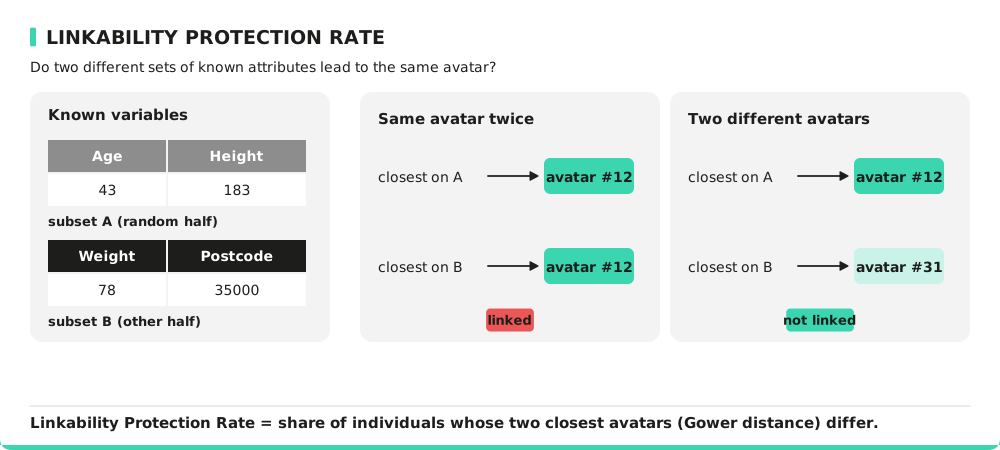
It quantifies the risk of correlation in synthetic datasets by simulating scenarios in which different subsets of variables are used to establish matches between avatars and their corresponding original records.
This metric directly addresses the risk of cross-linking, providing a robust measure of privacy protection.
The simulated scenario consists of selecting two distinct subsets of variables that could realistically be available in an external database (such as demographic information).
Each original individual from both subsets is then matched to their closest avatar within the feature space defined by the selected variables.
If an individual is linked to the same avatar across both subsets, this reveals a correlation risk for that individual.
Interpreting the Linkability Protection Rate
The Linkability Protection Rate is expressed as a percentage, where higher values indicate stronger protection.
A score of 100% means that no avatar was linked to the same original record across the different variable subsets — demonstrating complete dissociation between the synthetic and original data.
Conversely, lower values indicate a greater linkability risk, as some avatars maintain a stable association with their original record even when the linking variables change.
Consider a dataset where the Linkability Protection Rate is 85%.
This means that 85% of avatars could not be linked back to the same original record when tested using two different subsets of variables.
The remaining 15%, however, sustained a consistent match with the same individual, revealing a potential vulnerability in the synthetic data generation process.
Metric Specificity
This metric is particularly useful for datasets containing attributes likely to overlap across different contexts or domains.
By simulating a correlation attack scenario, in which different variable subsets are used to link avatars to original records, it provides a concrete measure of robustness for synthetic data.
It evaluates how effectively the Avatar method prevents exploitable correlations that could compromise anonymity by facilitating linkages between multiple datasets.
Formula
The known variables are shuffled and split into two halves and ( takes the extra variable when is odd). For each original record , the closest avatar is searched on each half with the Gower distance, ties being broken at random:
Numeric ranges are taken over originals and avatars together. The metric is not computed with fewer than two known variables.
How to Improve This Metric?
To improve the Linkability Protection Rate, it is recommended to increase the value of the k parameter — the number of neighbors considered during synthetic data generation.
A higher k increases the relative distance between an original record and its avatar, strengthening dissociation and enhancing resistance to linkability attacks, especially in contexts involving multiple data sources.