Single Tabular Data
This document describes the simple tabular data anonymization method developed by Octopize. This approach enables the anonymization of individual-level data, where each row corresponds to an independent individual. The method has been openly published1 in scientific literature and is also protected by a patent2. Its uniqueness lies in its individual-centric approach, ensuring high utility preservation while providing proven privacy.
Scope of application
This anonymization method operates under the following conditions:
Input Data: Requires pseudonymized data, meaning at this point there are no longer direct identifiers in the dataset.
Supported Data Types:
- Continuous variables (integer or float)
- Textual categorical variables (no matter the number of categories)
- Numeric categorical variables
- Boolean values
- Dates
- Missing data (the original distribution pattern of missing values will be preserved)
Scalability: Can process datasets ranging from a few dozen to several billion records efficiently. Large volumes of data are handled using a batch-parallelized approach, ensuring fast computation times.
Output
Avatars have the following properties with regard to the original data:
- Same structure: Same number of variables with the same encoding and variable names.
- Same granularity: Same number of records (1-for-1 mapping).
- Similar aggregates: Expect similar averages, sums, medians, etc., across all variables.
- Similar links: Similar correlations between variables.
- Similar clustering properties: Multivariate information within the dataset is preserved.
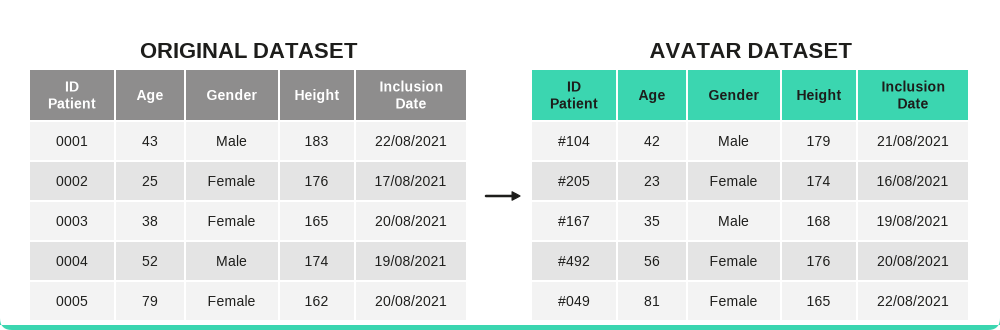
Core Algorithm
Global approach
In short, the core of the Avatar method follows three major steps.
- Input: the input data takes the form of a pseudonymized tabular dataset.
- The core of the Avatar method:
- a. Individual observations are projected into a complete multidimensional space.
- b. Using the first dimensions of this space, pairwise distances are computed between all sensitive individual observations to find the nearest neighbors used to define a local area.
- c. For each individual, a single avatar is pseudo-stochastically drawn in their local area. , , and other parameters drive the randomness and information content of the simulations.
- d. The properties of the avatar dataset are evaluated by computing re-identification and signal retention metrics.
- Output: the avatars are reverse-transformed from their coordinates in the projected space into values in the original space corresponding to the initial dataset. Synthetic observations (rows) are shuffled to remove the link between the original individuals and the avatars.
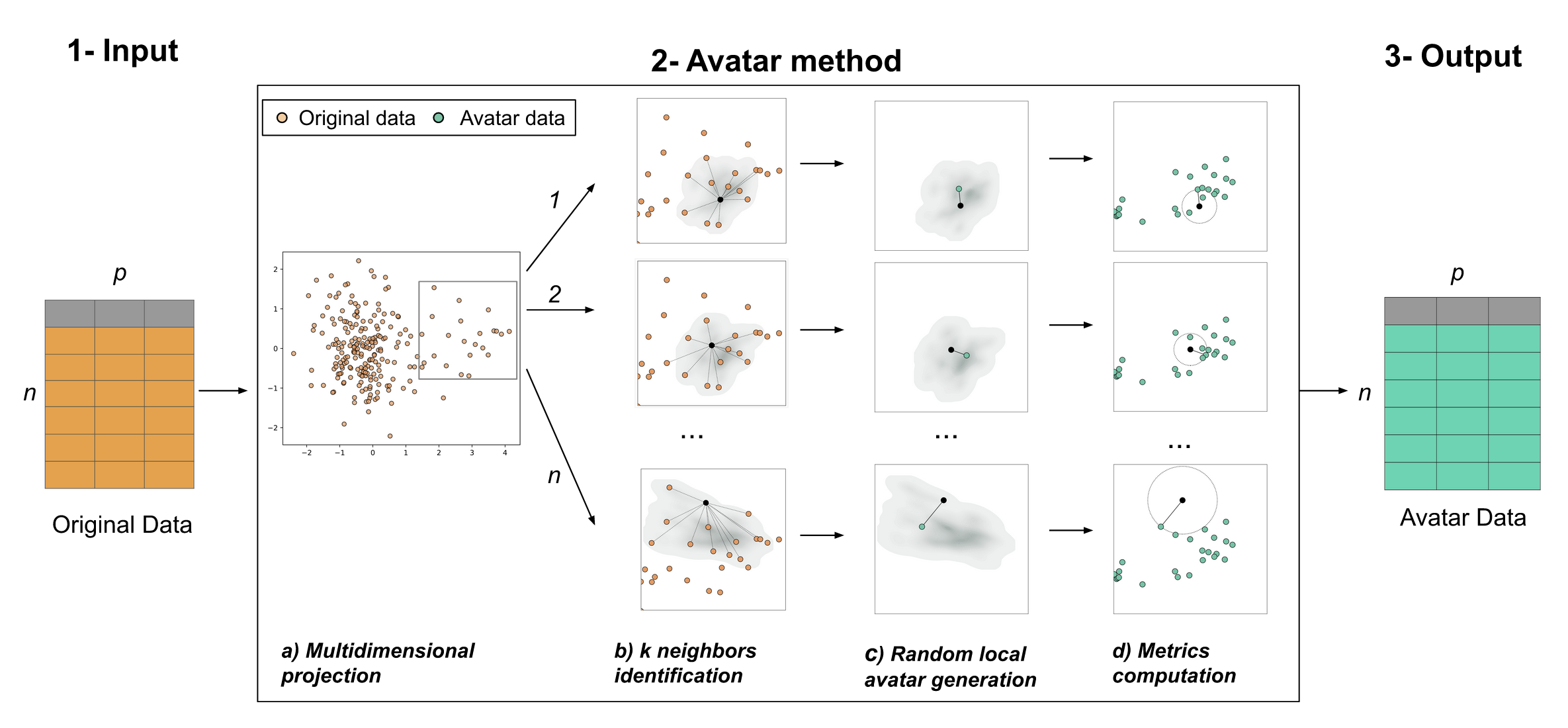
Figure 1: the Avatar method uses local modeling to stochastically generate a synthetic individual, termed an avatar.
Legend: (1) Original pseudonymized sensitive data. (2) The anonymization consists of four steps: (2a) individuals are projected in a multidimensional space; (2b) pairwise distances are computed to find the k nearest neighbors (here ) in a reduced space; (2c) a synthetic individual is pseudo-randomly generated in the subspace defined by the neighbors; (2d) privacy and utility metrics are evaluated. (3) Output of the synthetic dataset.
Synthetic coordinate generation
At step 2c. an avatar is generated for an individual at the weighted barycenter of its neighbors.
The weight of each neighbor is defined as follows:
Where:
- : distance between the individual and its neighbor k,
- : a random weight following an exponential distribution,
- : a contribution, where is the value at index of the randomly shuffled vector .
The weights are then normalized for their values to range between 0 and 1 as:
The avatar is generated at the weighted center of the nearest neighbors:
where,
- is the new coordinates of the individual's avatar.
- are the weights of its neighbors.
- the coordinates of its neighbors.
The Avatar coordinates are then inverse transformed in the original space using the inverse operation of the factor analysis technique used in step 2a.
Singularity of the approach
This anonymization method stands out due to its transparent and explainable design, allowing full control over the anonymization process and its evaluation. By generating data within a locally projected modeling space, the approach ensures the creation of plausible synthetic individuals preserving multivariate relationships.
Additionally, the introduction of controlled randomness guarantees the irreversible nature of the anonymization process. The individual-centric approach further enhances the assessment of residual risk, providing a more comprehensive evaluation of the privacy protection of the generated data.
Cite this page
If you use the avatar method in your research, please cite as follow:
Guillaudeux, M., Rousseau, O., Petot, J. et al. Patient-centric synthetic data generation, no reason to risk re-identification in biomedical data analysis. npj Digit. Med. 6, 37 (2023). https://doi.org/10.1038/s41746-023-00771-5