Knowledge Protection Rate
The Knowledge Protection Rate metric evaluates more probable and common attack scenarios, in which an attacker has partial knowledge of the original dataset.
It measures the system’s ability to protect the specific information of an individual against distance-based linkage attacks.
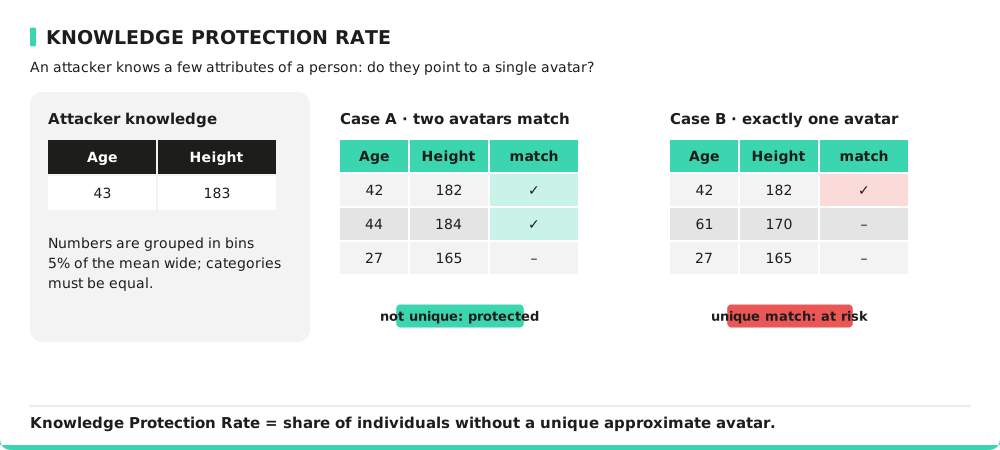
The metric quantifies the percentage of individuals for whom the attacker cannot successfully link an original record to a unique approximate avatar, based on the partial information they possess.
Uniqueness is essential: if multiple avatars match the attacker’s knowledge, the attacker cannot establish a certain link, which protects the individual with respect to the singling out criterion.
A tolerance threshold is applied to determine whether re-identification should be considered successful.
An avatar is considered approximating if:
- it shares the same categorical values, and
- its numerical values fall within a 5% tolerance interval.
Interpreting the Knowledge Protection Rate
The Knowledge Protection Rate returns the percentage of original individuals who do not have a unique approximate avatar in the synthetic dataset, based on a subset of variables likely to be known to the attacker (e.g., demographic information).
Suppose a dataset yields a Knowledge Protection Rate of 92%.
This means that for 92% of original individuals, the attacker cannot identify a unique approximate avatar in the synthetic data using the demographic information they possess.
Such a result indicates strong protection against distance-based linkage attacks.
Metric Specificity
This metric is particularly relevant in scenarios where the attacker has partial prior knowledge of the original data — a situation that frequently occurs in real-world contexts.
By focusing on demographic information, it evaluates the robustness of avatars against more targeted and realistic attack strategies.
Formula
The metric uses only the variables known to the attacker. Each numeric variable is cut into bins of width
(computed on the original records that occur once), and categorical values are kept as they are. Let be a record after binning, the original records that occur exactly once, and the binned avatar profiles that occur exactly once:
where is the total number of original records.
How to Improve This Metric?
To improve the Knowledge Protection Rate, it is recommended to increase the k parameter, which defines the number of neighbors considered during synthetic data generation.
A higher k value increases the relative distance between original data points and their corresponding avatars, thereby reinforcing dissociation and enhancing protection against distance-based linkage attacks.