Local cloaking
The Local Cloaking metric is specific to the Avatar method. It could be seen as a density metric. It is designed to address a distance-based record linkage attack scenario. This metric evaluates the loss of the link between an original data point and its avatar in a context where each individual generates their own synthetic data.
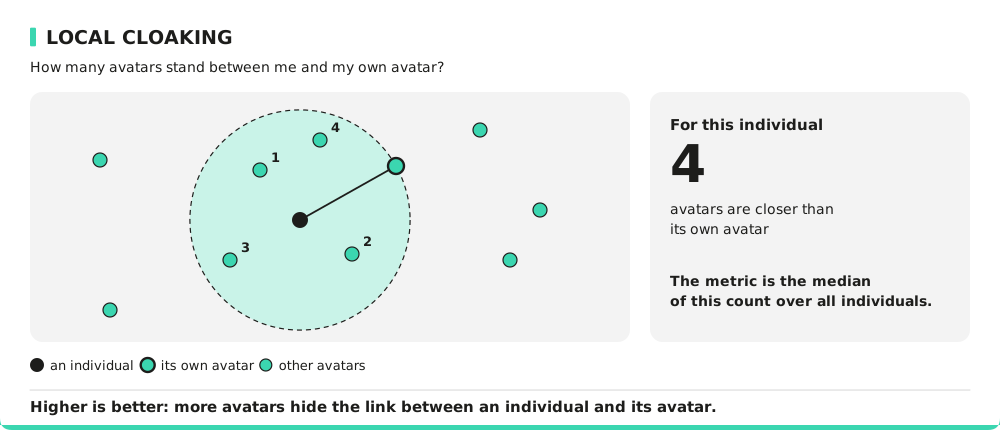
It quantifies how isolated an individual’s avatar is from their original data point by measuring the median number of other avatars positioned between the original data point and its avatar in the distance space.
Interpreting Local Cloaking
Local Cloaking can be interpreted as follows: it returns the median number of avatars located between an original data point and its avatar.
Suppose a dataset has a Local Cloaking value of 5. This means that, between an original data point and its avatar, there is a median of 5 other avatars that are closer to the original data point. This result reflects the dissociation between the original data and its avatar, making it more difficult for an attacker to establish a direct link.
Metric Specificity
This metric is particularly favorable for high-density datasets, meaning datasets where many individuals share similar characteristics. In such cases, the number of nearby avatars increases, further enhancing the dissociation between the original data points and their avatars.
Formula
With the number of avatars other than its own that are at least as close to as its own avatar :
Distances are Euclidean, computed in the projected space of the anonymization (first components).
How to Improve This Metric?
Improving the Local Cloaking metric can be achieved by increasing the k parameter, which represents the number of neighbors considered during the generation of synthetic data. A higher k value increases the relative distance between an original data point and its avatar, thereby strengthening dissociation and protection against record linkage attacks.