Hidden Rate
The Hidden Rate metric is a measure specific to the Avatar method. It is designed to address a distance-based record linkage attack scenario. This metric evaluates the loss of the link between an original data point and its avatar in the context of a method where each individual generates their own synthetic data. The Hidden Rate can also be seen as a safeguard that ensures there has been no algorithmic flaw and that the link between the original data and the synthetic data has been effectively broken.
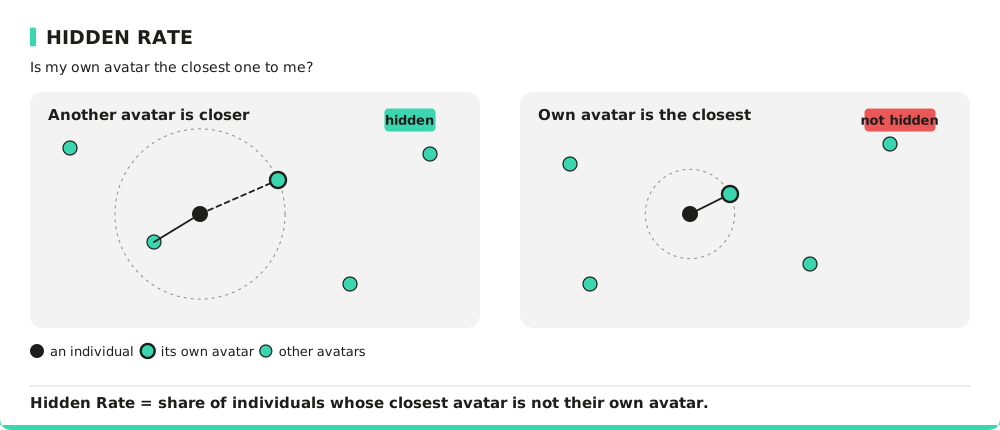
Interpreting Hidden Rate
The Hidden Rate can be interpreted as follows: it represents the percentage of individuals for whom the generated avatar is not the most similar entry in the dataset.
If a dataset has a Hidden Rate of 80%, this means that for 80% of individuals, the generated avatar is not the closest match in the dataset. However, this does not imply that the remaining 20% are at risk, as the individuals concerned are chosen randomly and remain unknown to an attacker.
Metric specificity
This metric is crucial for quantifying the effectiveness of the Avatar method in dissociating original data points from the generated avatars. By increasing the Hidden Rate, it becomes more challenging for an attacker to link an individual to their avatar with certainty, thereby strengthening the protection of personal data.
Formula
For each original record () with its own avatar , let be the number of other avatars that are at least as close as its own avatar:
An individual counts against the metric only when its own avatar is strictly its single closest avatar. Distances are Euclidean, computed in the projected space of the anonymization (first components).
How to Improve This Metric?
Improving the Hidden Rate metric can be achieved by increasing the k parameter, which represents the number of neighbors considered during the generation of synthetic data. A higher k value increases the relative distance between an original data point and its avatar, thereby strengthening dissociation and protection against record linkage attacks.