Column Direct Match Protection
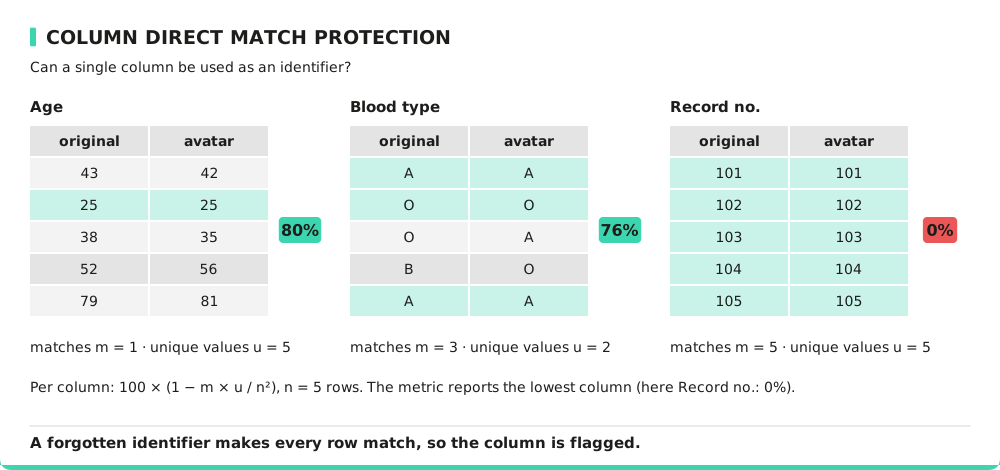
The Column Direct Match Protection metric evaluates a simpler attack scenario, where the goal is to check if a single column in the dataset allows for direct linking between an individual and their avatar. It measures the ability of each column to protect against re-identification by assessing if the most re-identifying column can isolate individuals and their avatars.
The metric is accompanied by a list of the most re-identifying columns, ranked in descending order of re-identification risk.
Interpreting Column Direct Match Protection
The Column Direct Match Protection returns the percentage of individuals whose data cannot be directly re-identified from the most re-identifying column in the dataset. A high percentage indicates that the most re-identifying column does not allow for re-identifying individuals, while a value close to 0 suggests that one or more columns contain information specific enough to re-identify individuals, such as a forgotten unique identifier.
Imagine a dataset where the Column Direct Match Protection is 10%. This means that 10% of the individuals in this dataset cannot be directly re-identified from the most re-identifying column. A score this low could indicate that a personal identifier was omitted during the anonymization process, allowing some individuals to be re-identified.
Metric Specificity
This metric is particularly useful when deciding to fix certain values during the anonymization process. It helps measure the impact of this decision on privacy and assess if certain variables might compromise anonymization. It is crucial to verify that columns do not contain quasi-identifying values or direct identifiers that could be used to re-identify individuals.
Formula
For each column , with the original value and the avatar value at the same row position:
Weighting by means that matches only weigh heavily for columns with many distinct values, such as identifiers. The columns whose falls below the target are listed with the result.
How to Improve This Metric?
To improve the Column Direct Match Protection, it is recommended to ensure that no identifiers or quasi-identifying values remain in the dataset being anonymized. It is also important to include all variables that could be used for direct identification of individuals in the anonymization process. By eliminating or modifying these variables, you strengthen the protection against re-identification.