Pairwise Correlation Difference
The Pairwise Correlation Difference (PCD) quantifies the overall difference in correlation structures between the original and transformed datasets. It is computed as the matrix norm of the difference between the Pearson correlation matrices of both datasets.
Mathematically:
where and are the correlation matrices of the original and transformed datasets, respectively.
A smaller PCD value indicates that the correlation structures in the transformed dataset are close to the original dataset.
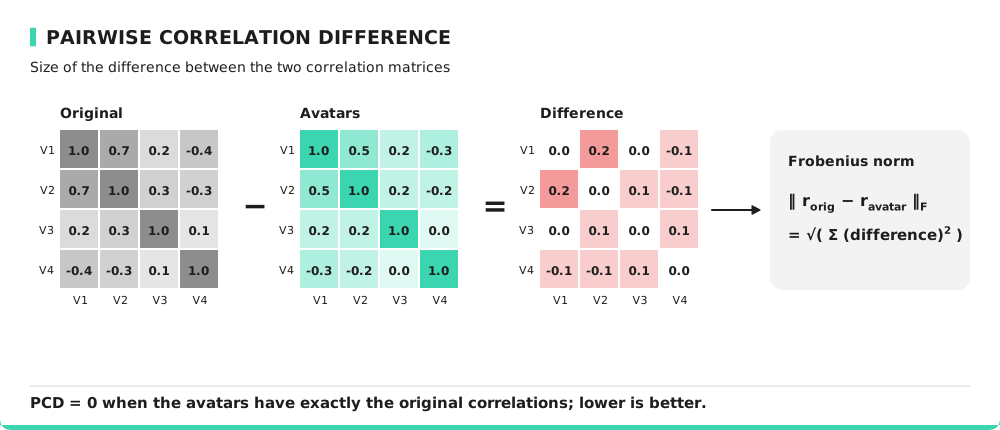
Interpreting Pairwise Correlation Difference
- PCD = 0: The transformed dataset has identical correlations to the original.
- Low PCD: The transformed dataset retains most correlation structures.
- High PCD: The correlations between variables have significantly changed, which may impact analysis reliability.
Suppose a dataset contains age, income, and education level. If the original dataset has high correlations (e.g., age vs. income = 0.65, education vs. income = 0.50), but the transformed dataset has lower correlations (0.30 and 0.20, respectively), the PCD metric would indicate a significant loss of correlation structure.
Metric Specificity
Advantages:
- Captures overall structural correlation differences rather than just single variable pairs.
- Easy to interpret: smaller values mean better correlation preservation.
- Useful when analyzing datasets with multiple correlated variables.
Limitations:
- Sensitive to transformations affecting multiple variables simultaneously.
- Does not capture non-linear relationships (only Pearson-based correlations).
- Ignores categorical variable relationships.
Formula
With and the Pearson correlation matrices of the original and avatar data (missing differences are set to 0):
How to Improve This Metric?
To lower Pairwise Correlation Difference similarity, you can adjust parameter k to help align distributions more accurately. You can also apply weighted projections by assigning higher importance to critical variables during data generation. Finally, you can use targeted data processing by apply transformations based on variable characteristics.